

November 23, 2026
For many buyers, searching for a home begins online. Property websites and listing platforms make it easier than ever to browse what’s available, compare neighborhoods and follow new properties as they come onto the market.
But not every home for sale is immediately available on those platforms.
Private listings have become an increasingly discussed part of the real estate industry, raising questions about how homes are marketed, who has access to them and what sellers should consider when deciding how to bring their property to market.
While a private introduction can offer certain advantages, it also comes with trade-offs. Understanding the different approaches can help buyers and sellers make more informed decisions.
Understanding the Different Stages of a Home Listing
Traditionally, sellers prepare their homes and bring them to market through a public listing, making the property available to a broad network of agents and prospective buyers.
A phased marketing approach offers another option. Rather than immediately launching a property publicly, a seller may choose to introduce it to a more limited audience first.
Depending on the strategy and applicable listing rules, this may involve several stages:
- Private Exclusive: The property is shared within a limited network of agents and prospective buyers.
- Coming Soon: The home receives broader visibility ahead of its full public launch, where permitted.
- Public Listing: The property is listed on the MLS and made available to a wider audience.
For some sellers, this staged approach provides an opportunity to gather initial feedback, assess buyer interest and refine their pricing or presentation before a broader launch.
What Does the Data Tell Us?
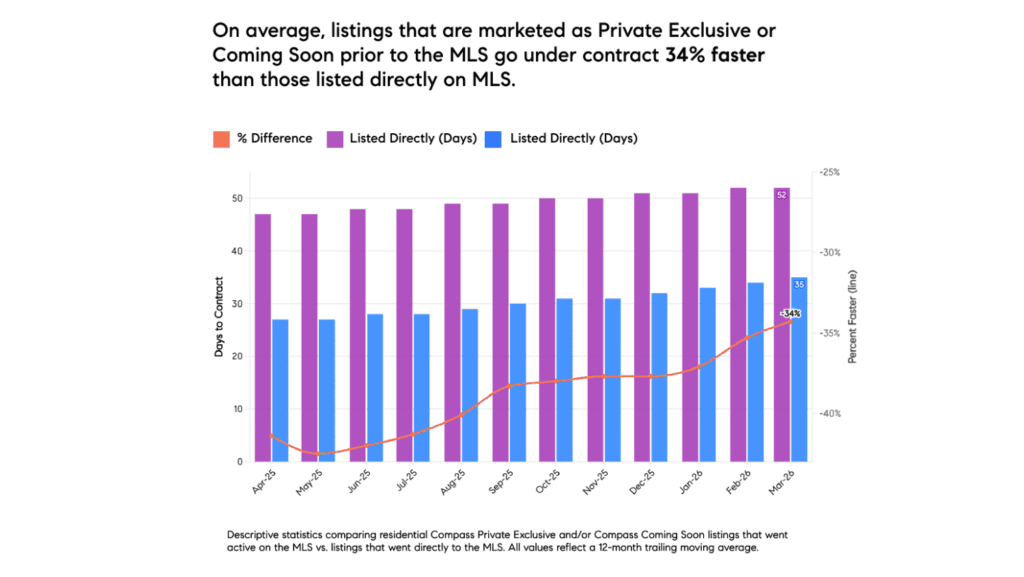
There is growing interest in whether pre-marketing a home can influence its eventual sale. Compass has published an analysis of more than 70,000 residential transactions across its markets, comparing homes that were pre-marketed as Private Exclusives and/or Coming Soon before going active on the MLS with homes that went directly to the MLS.
According to Compass, its analysis found that pre-marketed listings achieved:
- 4.6% higher closing prices on average.
- 34% faster time to contract once publicly listed.
- 29% lower likelihood of a price reduction once publicly listed.
The closing-price finding was based on a statistical analysis that controlled for other factors. The time-to-contract and price-reduction findings were descriptive comparisons.
These results offer an interesting perspective on the potential value of a phased marketing strategy. They are Compass’s own findings, however, and reflect its transactions across multiple markets and property types. They should not be viewed as a guarantee of results or as a prediction of what any individual home will achieve.
Local market conditions, property characteristics, pricing and buyer demand all continue to play an important role.
Why Might a Seller Consider a Private Listing?
There are several reasons a homeowner might prefer a more discreet approach to selling.
Privacy may be particularly important for sellers who don’t want photographs of their home widely circulated or who would prefer to keep their plans within a smaller circle.
A limited introduction to the market may also provide an opportunity to assess initial buyer interest, gather feedback and make adjustments before a broader launch.
For some homeowners, this flexibility can be appealing. Every seller has different priorities, and not everyone wants the same experience when bringing a property to market.
However, a more limited introduction also means fewer buyers may have an opportunity to discover the home during that initial phase. It’s important to weigh the value of discretion and early feedback against the potential benefits of wider exposure.
The Importance of Exposure and Transparency
One of the central questions surrounding private listings is how buyers gain access to properties that aren’t publicly advertised.
When a property is marketed publicly, it can reach a broad audience through the MLS and the many property platforms that draw from it. When a home is marketed privately, awareness of its availability may depend more heavily on an agent’s professional network and relationships.
For buyers, this can mean that not every available opportunity is visible through a typical online search. Having a clear conversation with an agent about their search criteria and the different ways properties are marketed can help them understand their options.
For sellers, it’s equally important to understand who will see the property at each stage, how feedback will be gathered and what opportunities may be missed by limiting initial exposure.

A Wider Conversation About the Future of Real Estate
The growing use of private listings has sparked a broader debate about how homes are bought and sold. As more properties are introduced through private networks before becoming publicly available, questions are emerging about what this means for the transparency and accessibility of the housing market.
For buyers, a more fragmented marketplace may mean looking beyond traditional listing platforms and working more closely with agents to understand what opportunities are available. For the industry, it raises questions about competition, access and whether buyers have a fair opportunity to discover homes that meet their needs.
There are also important questions about how the success of private marketing is measured. When a home sells before reaching the public market, it’s difficult to know whether a broader launch might have attracted additional interest or a different offer. These are considerations worth discussing alongside the potential advantages of a more controlled marketing process.
Is a Private Listing Always the Right Approach?
There is no single answer. A private introduction may make sense for a seller who places a high value on discretion, wants to assess initial interest or has a particular reason to approach the market gradually.
For another seller, a full public launch from the outset may be the better option, particularly if reaching the widest possible pool of buyers and encouraging competition are important priorities.
The right strategy depends on the property, the seller’s circumstances, current market conditions and the potential benefits and compromises of each approach.
It’s also worth considering how success will be measured. Is the priority privacy, convenience, timing or achieving the strongest possible sale price? These considerations can lead to different marketing decisions.

Making an Informed Decision
The way homes are marketed continues to evolve, and private listings are likely to remain part of the wider conversation about the real estate industry.
For sellers, the most important thing is understanding the options available and having an honest discussion about the potential advantages and limitations of each. For buyers, it’s helpful to recognize that publicly available listings may not always represent every opportunity in the market.
Ultimately, a thoughtful real estate strategy should be built around the needs of the individual client, with clear advice, careful planning and an understanding of the local market.
Whether a home is introduced privately or launched publicly, buyers and sellers deserve to understand how the process works and what it means for them.
Further Listening
Interested in the wider conversation? Listen to A Raging Battle Over How Homes Are Sold from The Wall Street Journal’s The Journal podcast, which explores the growing debate around private listings and the changing real estate landscape.